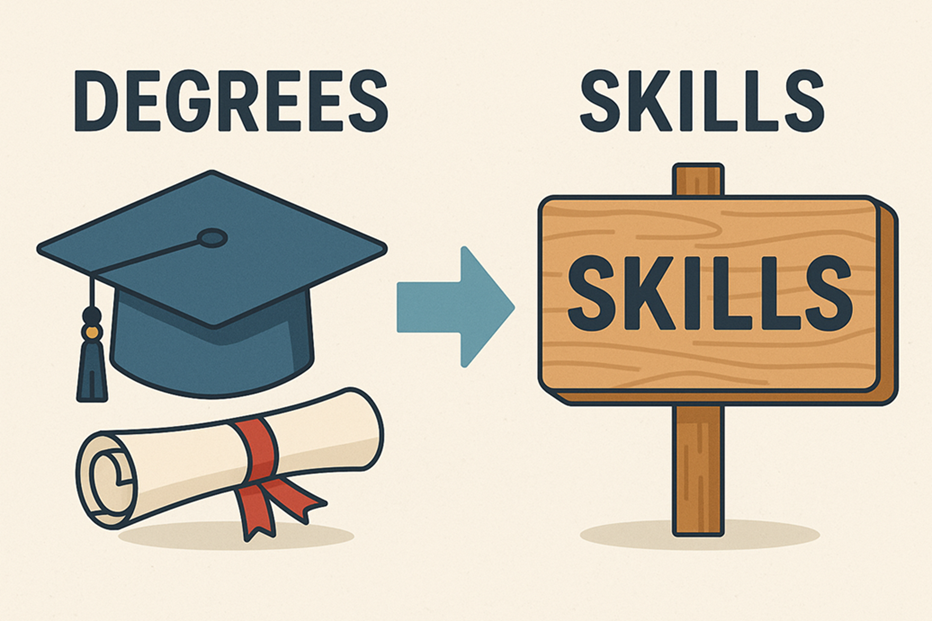
The landscape of professional qualification is undergoing its most significant transformation since the establishment of the modern university. For centuries, the traditional four-year degree has stood as the undisputed gatekeeper of career opportunity, a signal of discipline and intelligence that employers trusted. However, the seismic shifts in technology, the economy, and the very nature of work have cracked the foundation of this monopoly. In its place, a more agile, accessible, and practical alternative is rising: micro-credentials. This article explores the “Cambrian explosion” of these short, focused certifications and investigates a pressing question: Are we witnessing the end of the degree era?
The Shifting Paradigm: From Degrees to Demonstrated Skills
The term “micro-credential” is an umbrella category encompassing digital badges, industry certifications, nano-degrees, and licenses . Unlike the broad, theoretical curriculum of a bachelor’s program, micro-credentials validate specific, job-ready skills. A computer science degree might cover the history of computation, advanced calculus, and data structures; a micro-credential in Python verifies that a candidate can actually code in Python.
This distinction is critical in the modern labor market. According to recent data, an astounding 1.5 million unique non-degree credentials (NDCs) now exist in the United States alone, with the number appearing on resumes jumping nearly 35% in the past year . This explosion is a direct response to two pressures: the rapid obsolescence of skills driven by generative AI and a growing skepticism among employers regarding the adaptability of new graduates .
Defining the Difference
To understand the shift, one must understand the vocabulary. A traditional degree is a “macro-credential”—a comprehensive portfolio of learning designed to provide foundational knowledge and critical thinking skills over several years. In contrast, micro-credentials are targeted. As defined by UNESCO, they address specific learning outcomes in a narrow field over a short duration . They are often:
-
Stackable: Multiple credentials can be combined into a larger qualification.
-
Verifiable: Digital badges contain metadata detailing the issuer and assessment criteria.
-
Competency-Based: They require demonstration of skill, not just attendance.
Why the Traditional Degree Model Is Fraying
The four-year degree is not obsolete, but its flaws have become too significant to ignore. The primary drivers pushing employers and learners toward micro-credentials are cost, time, and relevance.
A. The Crushing Burden of Cost and Time
The financial barrier to entry for a degree has become prohibitive for many. Data from the College Board indicates that the average cost of tuition and fees at a public four-year college is approximately $11,610 per year for in-state students, with private institutions averaging over $40,000 annually . This represents a four-year commitment of both time and money. Micro-credentials, conversely, typically cost a fraction of that—often less than $10,000 for an entire program—and can be completed in weeks or months .
B. The Skills Gap and the Relevance Crisis
Perhaps the most significant failing of the traditional system is its inability to keep pace with industry needs. Employers frequently report that graduates lack the practical, hands-on abilities required for the roles they are hired to fill. “Higher education often fails to provide graduates with the essential skills required for modern employment opportunities,” notes Gordon Pelosse of AICerts .
In fields like cybersecurity, digital marketing, and data analytics, the curriculum taught in a freshman year may be outdated by the time that student graduates four years later. Micro-credentials solve this by offering “just-in-time” learning. For example, an IT professional can earn a credential in AI-Driven Cybersecurity within a semester, immediately applying that knowledge to defend their network against emerging threats .

The Economic Reality: Do Micro-Credentials Pay Off?
The value of any educational investment is ultimately measured by its return. Recent comprehensive analysis of over 156 million U.S. resumes by the Brookings Institution provides the clearest picture yet of how micro-credentials impact wages . The findings confirm that micro-credentials are not just hype; they are economic drivers, but only under specific conditions.
Relevance Is Everything
The data shows that a worker’s first job-relevant micro-credential is associated with a 3.8% wage premium—more than double the 1.8% premium for a credential irrelevant to their occupation . Stacking multiple relevant credentials adds value; stacking irrelevant ones yields zero marginal return. For workers without a bachelor’s degree, the impact is even more dramatic: a first job-relevant NDC boosts wages by an average of 6.8% , nearly double the return seen by college graduates .
This suggests that micro-credentials function best as targeted tools for specialization and upskilling within a specific career path, rather than as general resume padding.
A Global Movement: How the World Is Adopting Micro-Credentials
The shift toward micro-credentials is not confined to the United States; it is a global phenomenon. Governments and universities worldwide are building frameworks to integrate these short courses into their educational fabric .
A. Asia’s Rapid Integration
Asian economies are leveraging micro-credentials to enhance workforce competitiveness. Singapore views lifelong learning as a national strategy, with institutions like the National University of Singapore (NUS) integrating short-term courses into degree programs . In India, the National Education Policy 2020 allows for up to 50-70% of undergraduate programs at skill-focused institutions to consist of credit-based micro-certificates . Thailand’s Sukhothai Thammathirat Open University utilizes a “credit bank” system, where work experience and online courses can be converted into academic units .
B. European Standardization
The European Union is working toward a Common Micro-credential Framework to ensure portability across member states. This system aligns micro-credentials with the European Credit Transfer and Accumulation System (ECTS), allowing a short course taken in Spain to count toward a degree in Germany .
C. North American Innovation
In the U.S. and Canada, initiatives like “Credentials as You Go” advocate for incremental credentials that can be awarded as students work toward larger degrees . Universities such as Syracuse and the University of Arizona are leading the charge, offering microcredentials that act as on-ramps to full degrees or as standalone validations of expertise .
The Stackable Ecosystem: Building Your Own Degree
One of the most powerful concepts in the micro-credential revolution is stackability. This allows learners to build qualifications piece by piece, much like assembling Lego blocks. Instead of committing to a two-year MBA, a professional might earn a series of micro-credentials in Project Management, Data Analytics, and Leadership, which together constitute a “macro-credential” equivalent to a graduate certificate .
This model benefits:
-
Students: They can pause their education to work and return later without losing progress.
-
Employers: They can curate specific learning paths for employees to fill exact skill gaps within the company.
-
Universities: They can attract working professionals who would never enroll in a full-time, multi-year program .
Community colleges are particularly adept at this. Institutions like Ivy Tech Community College in Indiana partner with high schools to offer over 100 courses where students can earn credentials in fields like welding and automation before they even graduate high school .
The Role of Technology: Blockchain and AI in Credentialing
The credibility of micro-credentials rests on their verifiability. This is where technology, specifically blockchain, plays a crucial role. Unlike paper diplomas, digital badges can be “minted” with unique metadata on a decentralized ledger, making them tamper-proof and instantly verifiable by employers .
Furthermore, Artificial Intelligence is personalizing the learning journey. AI-powered platforms can analyze a worker’s current skill set and career goals, recommending a tailored sequence of micro-credentials to address specific gaps. This ensures that professional development is strategic rather than random .
Navigating the Pitfalls: Quality and Accountability
Despite the optimism, the micro-credential boom presents significant risks. The market is crowded and largely unregulated. With over a million options available, workers face an “opaque, high-stakes gamble” in distinguishing valuable programs from worthless ones .
The expansion of Workforce Pell Grants to cover short-term programs has raised the stakes. While this directs billions toward workforce development, it also risks funneling public money into low-value programs if proper guardrails aren’t in place .
To combat this, experts suggest several measures:
-
Standardized Metadata: Providers should publish data on skills taught, assessment methods, and student outcomes.
-
Third-Party Validation: Organizations like the IEEE are stepping in to certify micro-credential providers, ensuring they meet rigorous industry standards .
-
State-Level Accountability: States like North Carolina only designate credentials as eligible for scholarships if data proves they lead to employment in high-growth fields .
The Employer Perspective: A Skills-First Revolution
For human resources leaders and business executives, the rise of micro-credentials offers a solution to a long-standing problem: the “degree inflation” that excluded talented individuals who lacked a diploma but possessed the necessary skills.
Companies are increasingly adopting skills-first hiring strategies. They recognize that a candidate with a verified micro-credential in a specific software or methodology may require less training than a candidate with a general degree . A staggering 85% of employers now prioritize demonstrable, job-ready skills over traditional credentials in certain fields .
Forbes Councils member Gordon Pelosse advises business leaders to recognize that “learning methodologies are evolving to become more skills-centered,” and that hiring strategies must adapt to encourage agility and a learning mindset .
The Future of Higher Education: A Hybrid Model
So, will micro-credentials replace degrees? The consensus among experts is nuanced. In highly regulated professions requiring extensive theoretical grounding such as medicine, law, and advanced academic research—the full degree will remain indispensable .
However, for the vast majority of roles in technology, business, and skilled trades, the future points to a hybrid model. Universities will likely serve as hubs where students mix and match:
-
Traditional foundational courses (theory, ethics, communication).
-
Stackable micro-credentials (specific technical skills, industry certifications).
-
Real-world project experience.
As Bryan Penprase notes in Forbes, institutions that resist this shift risk being left behind. The role of the university is evolving from the sole “guardian of knowledge” to a facilitator of lifelong learning and credentialing .

Conclusion
The era of the degree as the sole arbiter of employability is ending. Micro-credentials have emerged not just as an alternative, but as a necessary evolution in a world where technology continuously reshapes the job market. They offer a more democratic, flexible, and targeted path to economic mobility, particularly for early-career workers and those without college degrees .
While challenges of quality control and standardization remain, the momentum is undeniable. With policy support from initiatives like the Workforce Pell expansion and technological advances in blockchain verification, micro-credentials are poised to become a permanent and prominent feature of the educational landscape . For the modern professional, the question is no longer whether to engage with micro-credentials, but which ones will unlock the next chapter of their career.